OFAC OFSI EU Comparison: What Compliance Teams Need
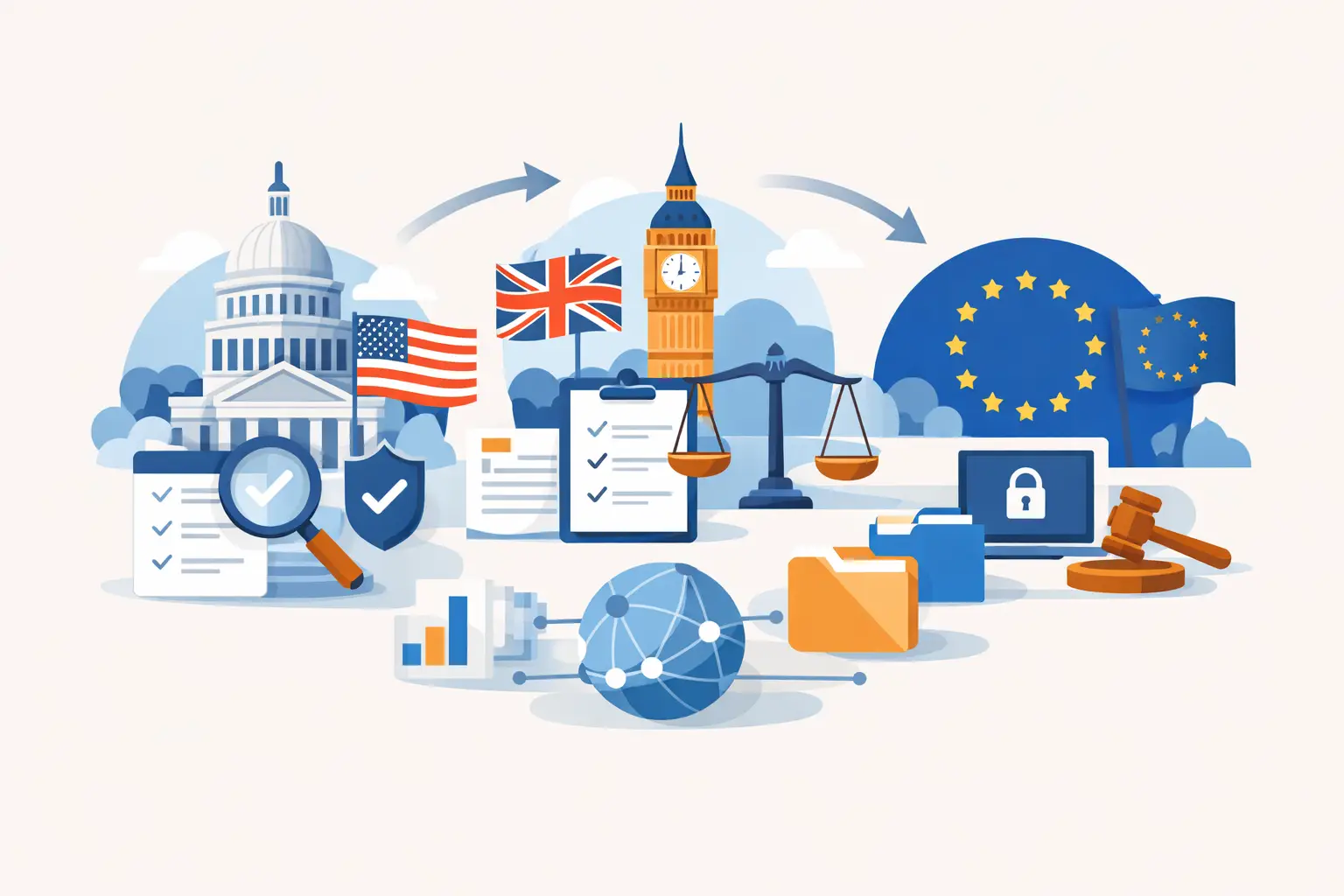
A single name can trigger three materially different sanctions assessments. That is the operational reality behind an OFAC OFSI EU comparison. US, UK, and EU sanctions frameworks overlap frequently, especially in major country programs, but they do not apply through the same legal tests, licensing routes, ownership rules, or enforcement models. Treating them as interchangeable creates avoidable blocking errors, missed reporting obligations, and weak audit trails.
For internationally active financial institutions, the question is not which list is more comprehensive. The question is which regime applies to the customer, transaction, asset, and relevant persons at each point in the payment chain.
OFAC OFSI EU Comparison: Three Frameworks, Different Effects
The Office of Foreign Assets Control, or OFAC, administers and enforces US economic and trade sanctions. Its restrictions generally apply to US persons, including US citizens and permanent residents wherever located, entities organized under US law and their foreign branches, and transactions that take place in the United States. The US dollar, US financial institutions, US-origin goods, and US nexus can each introduce meaningful exposure, although their relevance depends on the applicable program and facts.
The Office of Financial Sanctions Implementation, or OFSI, implements UK financial sanctions. Its jurisdiction covers conduct in the United Kingdom, UK persons wherever they are located, and UK-incorporated entities. OFSI is both a policy-facing and enforcement-focused authority. Its enforcement posture has made sanctions governance, reporting discipline, and evidence of reasonable controls central concerns for regulated firms.
EU sanctions are adopted by the Council of the European Union. Regulations are directly applicable across EU member states, while national competent authorities administer licensing, supervise compliance, and impose penalties under their domestic frameworks. That division matters: an EU-wide prohibition may be clear, but practical questions about authorizations, reporting, and enforcement can require country-specific analysis.
The result is a structural difference in how teams should work. OFAC and OFSI are single national authorities with centralized guidance and licensing functions. The EU creates common sanctions obligations, but implementation activity is distributed across member states. A policy that refers simply to “EU sanctions” without naming the relevant member-state process is often incomplete.
List Matching Is Only the First Decision
Screening against OFAC’s Specially Designated Nationals and Blocked Persons List, the UK Sanctions List, and the EU consolidated list is essential. It is not, however, a complete sanctions control.
A direct list match creates an urgent escalation. But the harder cases concern entities that are not named, parties controlled through layered ownership, and transactions involving sanctioned jurisdictions without an obvious listed counterparty. Those questions cannot be resolved by a name-screening result alone.
OFAC’s 50 Percent Rule is particularly consequential. An entity is treated as blocked when one or more blocked persons own, directly or indirectly, 50% or more of it in aggregate. The entity may not appear on the SDN List. A screen that does not connect ownership data to OFAC’s aggregation test can therefore miss a blocked party.
The UK takes a broader ownership and control approach. Ownership is relevant, but a designated person can also control an entity through voting rights, board appointment rights, or other means. The analysis is fact-specific. A simple percentage threshold may identify a risk indicator, but it cannot replace a documented assessment of control.
EU restrictive measures similarly require firms to consider ownership and control, rather than relying only on the consolidated list. The applicable legal regime, EU guidance, and national authority expectations should be assessed carefully. In complex corporate structures, legal ownership, practical influence, beneficial ownership, and the ability to direct assets may point in different directions.
This is where false consistency becomes dangerous. Applying OFAC’s 50% test as if it were the complete UK or EU answer can produce under-escalation. Applying the broadest possible control interpretation to every case can unnecessarily freeze legitimate activity. The right decision depends on the governing regime, verified corporate information, and a clear record of how the institution reached its conclusion.
Territorial Scope Changes the Answer
A multinational institution may have a US parent, a UK booking entity, an EU branch, and a payment route through a correspondent bank. Each connection can change the sanctions analysis.
For OFAC purposes, the location and status of persons involved are central. A non-US subsidiary may not always be subject to every US program in the same way as its US parent, but US-person involvement, US systems, US-dollar clearing, or US-origin goods can create significant risk. Firms should avoid simplistic assumptions that either overstate universal OFAC reach or ignore genuine US nexus.
For OFSI, a UK employee approving a transaction, a UK entity holding an account, or activity occurring in the UK can bring the matter within scope. For EU sanctions, obligations can apply to persons within EU territory, EU nationals, entities incorporated under the law of a member state, and conduct connected to EU jurisdiction. The precise perimeter should be mapped to the transaction rather than inferred from a group headquarters address.
Crypto businesses face the same problem in a different form. A wallet address may be tied to a designated person, an exchange may operate across several jurisdictions, and the personnel approving a transfer may sit elsewhere. Sanctions exposure is determined by legal nexus and prohibited conduct, not by the borderless appearance of the technology.
Licensing Is Not a Universal Permission Slip
All three frameworks provide routes for permitted activity, but a license under one regime does not automatically authorize conduct under another.
OFAC issues general licenses for defined categories of activity and specific licenses for fact-specific requests. OFSI also uses general and specific licenses, subject to the terms, conditions, expiration dates, and reporting requirements of each authorization. Under EU sanctions, derogations and authorizations are typically handled by the relevant national competent authority under the applicable EU regulation.
A compliance team considering a payment involving blocked funds, humanitarian activity, legal services, wind-down activity, or a contractual claim should ask three separate questions: which restrictions apply, whether a relevant authorization exists, and whether its conditions are met. A license must be read as an operative legal instrument, not treated as a broad commercial exemption.
That includes checking party scope, activity scope, dates, payment routes, recordkeeping, notifications, and reporting. An authorization can fail to protect a transaction if the actual facts depart from the licensed facts, even where the commercial purpose appears similar.
What a Defensible Cross-Border Control Looks Like
An effective sanctions framework separates data capture, legal analysis, operational decision-making, and evidence retention. Combining all four in a single analyst spreadsheet is difficult to sustain as lists change, ownership structures evolve, and regulators ask for proof.
At minimum, teams need four connected capabilities:
- Screening that covers official lists and credible supplementary sanctions sources, with strong matching logic and documented disposition workflows.
- Entity resolution that links legal names, aliases, identifiers, beneficial owners, directors, wallet addresses where relevant, and corporate relationships.
- Jurisdictional rules that distinguish OFAC, OFSI, EU, and applicable member-state requirements rather than applying one generic sanctions standard.
- Case evidence that records the facts reviewed, sources used, legal rationale, approvals, licensing analysis, reporting decisions, and subsequent monitoring.
The operating model matters as much as the technology. First-line teams need practical escalation criteria. Sanctions specialists need authority to assess ownership, control, and nexus. Legal teams need access to the evidence behind a decision. Internal audit needs to test whether the written policy reflects actual practice.
Manual research tends to fracture at exactly these handoffs. Analysts may identify a potential ownership issue but lack current guidance; legal may give advice that is not translated into a repeatable workflow; operations may execute an action without preserving the underlying rationale. That is how a technically sound policy becomes an operationally weak control.
Specialized sanctions intelligence can reduce this gap by bringing official designations, regulatory guidance, ownership research, and cross-jurisdiction comparison into the same case workflow. Sherlocq is designed for that practitioner problem: helping teams investigate sanctions exposure across OFAC, OFSI, EU, and broader data sources while retaining source-backed analysis for review and challenge.
The Comparison That Matters in Practice
The useful OFAC OFSI EU comparison is not a table of list names. It is a transaction-level decision process: identify the parties and ownership chain, establish the relevant jurisdictional nexus, test restrictions under each applicable framework, assess available authorizations, and preserve the rationale.
When the facts are uncertain, escalation should be treated as a control outcome, not a failure of efficiency. The strongest sanctions programs do not promise that every case will be simple. They ensure that the complex cases reach the right people with the right evidence before money, assets, or services move.