Compliance Workflow Automation for Banks
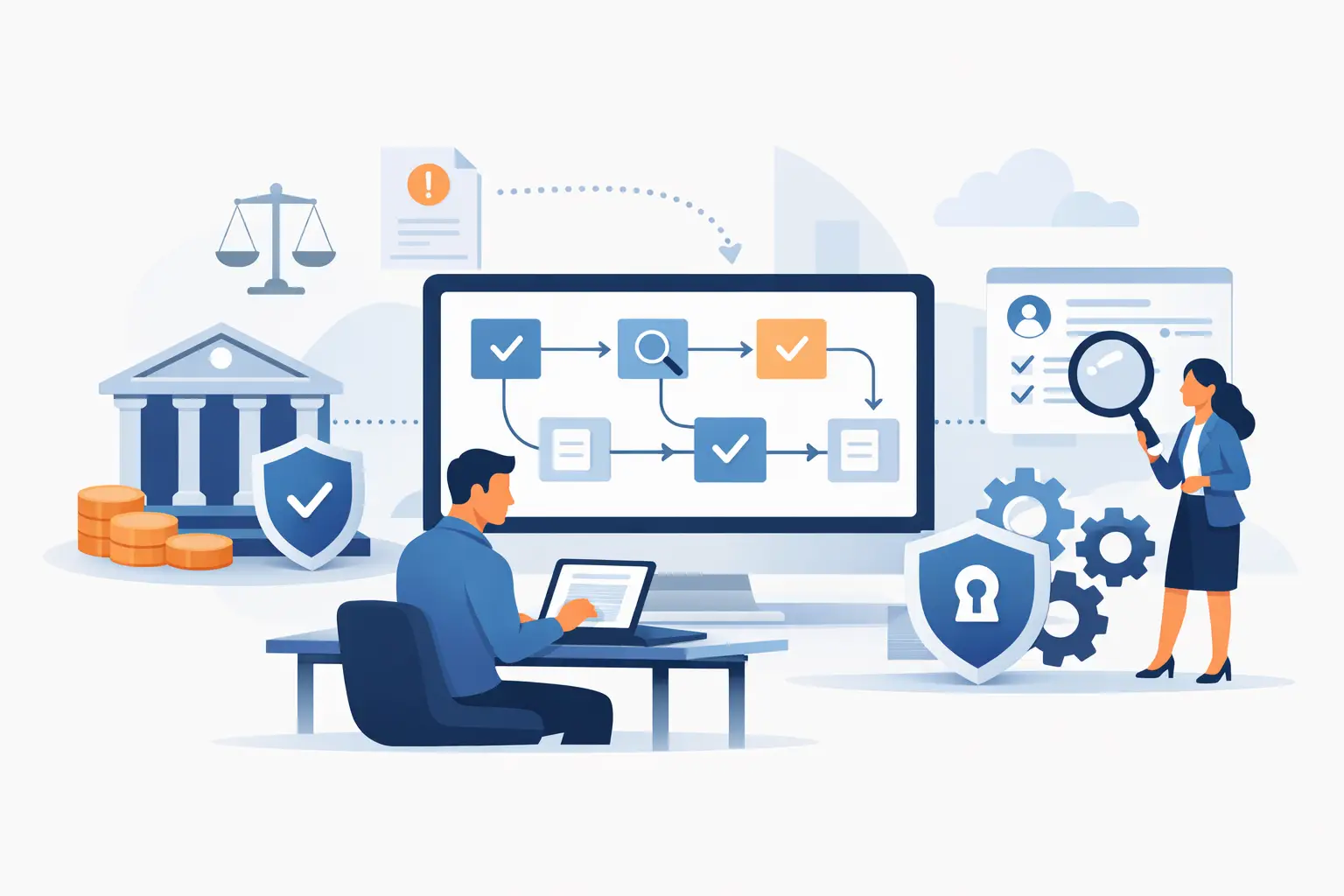
A supervisory finding rarely begins with a lack of policy. More often, the institution had the relevant obligation somewhere in its regulatory inventory, but no reliable way to convert it into a completed, evidenced action across the business. Compliance workflow automation for banks addresses that operational gap: it connects regulatory intelligence, ownership, review, approval, testing, and audit evidence in one controlled process.
For compliance leaders, the issue is not whether to automate. It is which decisions and handoffs can be automated without weakening judgment, accountability, or the defensibility of the final outcome. The distinction matters. A poorly designed workflow can move a weak assessment through the organization faster. A well-designed one makes regulatory change visible, assigns it to the right people, and preserves the rationale behind every material decision.
Why manual compliance workflows fail under pressure
Banks face a persistent mismatch between the volume of regulatory change and the capacity of compliance teams to interpret and operationalize it. A single development may affect multiple legal entities, products, customer segments, geographies, policies, controls, training materials, and monitoring scenarios. That complexity rises sharply for institutions operating across the United States, the United Kingdom, the European Union, Asia, and the Middle East.
Manual workflows are usually built around inboxes, spreadsheets, shared folders, and periodic status meetings. Those tools can work for contained reviews. They break down when the institution needs to demonstrate, months later, which regulatory source was assessed, who determined applicability, which control owner accepted the change, and whether remediation was tested before closure.
The consequences are operational as well as regulatory. Subject matter experts spend time chasing updates instead of analyzing requirements. Compliance managers cannot distinguish genuinely blocked work from work that has simply gone stale. Senior management receives activity reports rather than a clear view of residual exposure. During an audit or examination, evidence must be reconstructed from fragmented systems and personal correspondence.
Automation is valuable because it imposes structure on these moments. It does not eliminate expert review. It ensures that expert review happens at the right stage, against the correct source material, with a record that can withstand scrutiny.
What compliance workflow automation for banks should do
The strongest workflow programs begin with a defined regulatory event and end with evidenced closure. Between those points, the system should establish clear ownership, deadlines, escalation, and decision records. The objective is not to create a larger queue. It is to create a controlled chain from obligation to implementation.
Start with source-backed regulatory change
A workflow is only as reliable as the intelligence that initiates it. Banks need a disciplined method to capture new rules, supervisory guidance, enforcement trends, sanctions developments, and consultation outcomes relevant to their business. Generic news alerts are insufficient when applicability depends on a specific jurisdiction, license type, customer relationship, or activity.
Regulatory intelligence should be classified before it enters the workflow. Is the development final, proposed, effective immediately, or subject to a transition period? Which entities, products, and control domains may be affected? What is the underlying primary source? These questions determine whether the item should be logged for awareness, assigned for impact assessment, or escalated as an urgent implementation issue.
A specialized platform such as Sherlocq can shorten the research stage by providing practitioner-focused, cited answers across jurisdictions. But the operational value comes when that answer becomes a controlled action: an assigned assessment with a source record, a due date, and an accountable decision-maker.
Route work by risk and expertise
Not every regulatory update deserves the same workflow. A formatting change to a routine filing should not follow the same path as a new anti-money laundering requirement affecting onboarding, transaction monitoring, and correspondent banking. Automation should use risk-based routing to direct work according to the potential impact, implementation deadline, jurisdiction, and affected control domain.
For example, a sanctions designation may need immediate routing to sanctions operations, financial crime compliance, legal, and relevant business teams. A prudential reporting change may be directed to regulatory reporting, finance, data governance, and model risk. The workflow should set mandatory reviewers where appropriate, while allowing compliance leadership to add specialists when the facts require it.
This is where over-automation becomes a risk. Routing rules should be transparent and regularly tested. If a business line or legal entity is absent from the underlying taxonomy, the system may create false confidence by assigning the task perfectly to the wrong group.
Turn impact assessments into accountable decisions
Impact assessments are often treated as a narrative exercise. The better approach is to require structured decisions alongside analysis. The assessor should determine whether the requirement applies, identify affected policies and controls, describe the gap, estimate risk, propose remediation, and record any assumptions or legal interpretations.
Structured fields make reporting and challenge easier, but they should not force complex regulatory analysis into a simplistic yes-or-no answer. A bank may conclude that a rule is not currently applicable but becomes relevant if it launches a product, enters a market, or changes its customer profile. The workflow should allow conditional applicability, documented triggers, and scheduled reassessment.
Material conclusions should move through approval gates. Compliance may own interpretation, but implementation ownership usually sits elsewhere. Control owners need to confirm feasibility, technology teams may need to assess system changes, and legal may need to validate a position on scope. Automation makes these dependencies explicit rather than leaving them implied in an email thread.
Link remediation to controls and evidence
Closure should never mean that a task was marked complete. It should mean that the bank can show how it addressed the identified obligation. That may involve a revised policy, updated customer due diligence procedures, a changed transaction-monitoring rule, staff training, new management information, or a formal risk acceptance.
The workflow should connect remediation items to the relevant control inventory and preserve evidence of implementation. It should also distinguish implementation from validation. A policy can be approved without being embedded in operational practice. A system change can be deployed without showing that it performs as intended.
For high-risk changes, a second-line review or targeted control test should be a required stage before closure. Internal audit may not need to approve every action, but it should be able to trace the full decision history without relying on the memory of former employees.
Design for exceptions, not just the happy path
Banks do not operate in clean, linear conditions. Regulatory deadlines can change. An issue may span several jurisdictions with conflicting requirements. A remediation item may depend on a core technology release that cannot be accelerated. Effective automation anticipates these exceptions.
A mature workflow includes escalation rules for overdue assessments, unresolved disagreements, high residual risk, and missed implementation dates. It also supports formal extensions and risk acceptance, with appropriate seniority thresholds. The goal is not to eliminate delays from reporting. It is to make their implications visible early enough for management to act.
This is particularly important for cross-border institutions. Central compliance functions need consistent reporting, while local teams need room to apply jurisdiction-specific requirements. A global workflow should standardize the minimum evidence, approval logic, and reporting taxonomy without assuming that every local implementation will be identical.
Measure whether automation is improving control
The wrong metrics encourage the wrong behavior. Counting closed tasks can reward premature closure. Counting alerts can reward noise. Banks should focus on measures that show whether the regulatory change process is timely, risk-sensitive, and defensible.
Useful indicators include the time from regulatory publication to triage, the percentage of material items assessed before their effective date, overdue actions by risk rating, approval turnaround time, repeat findings linked to previously remediated issues, and the percentage of closed items with complete evidence. Management reporting should also identify concentration risk, such as multiple critical changes dependent on the same technology team or control owner.
These metrics are not merely operational. They help boards, risk committees, and senior management understand whether compliance capacity is aligned with the institution’s regulatory exposure.
The implementation question is governance first, technology second
A bank can deploy workflow software quickly and still fail to improve compliance execution if the underlying operating model is unclear. Before configuring technology, define the regulatory change taxonomy, ownership model, materiality thresholds, escalation paths, evidence standards, and closure criteria. Then configure the workflow around those decisions.
Begin with a high-value use case rather than attempting an enterprise-wide transformation on day one. Regulatory change management, sanctions alert escalation, policy review, and issue remediation are often suitable starting points because their handoffs and evidence needs are already visible. Once the bank has proven adoption and reporting quality, it can extend the model to adjacent processes.
The test is straightforward: when the next significant regulatory development arrives, can the institution show not only that it heard about it, but how it reached, implemented, tested, and governed its response? That is the standard compliance workflow automation should be built to meet.