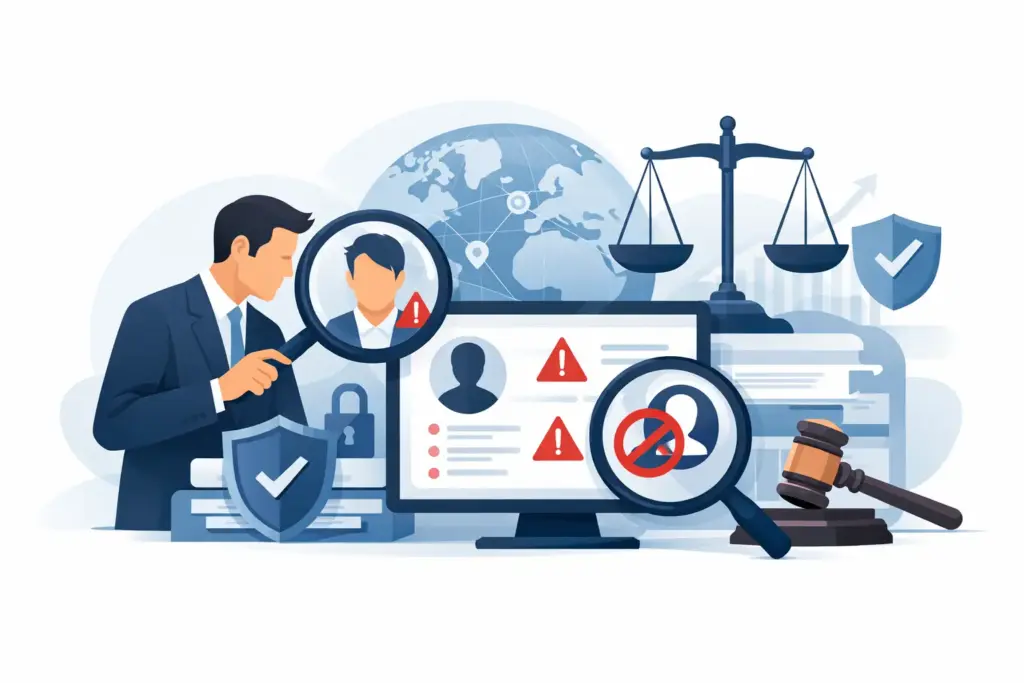
What a Regulatory Research Software Review Must Test
A missed regulatory update rarely looks expensive on the day it is missed. The cost appears later: a delayed product launch, a control that cannot be evidenced, an audit finding, or an enforcement question that exposes how the organization reached its conclusion. A regulatory research software review should therefore assess more than search speed or an impressive AI demonstration. It should establish whether a platform can produce reliable, defensible intelligence under the operating pressure compliance teams actually face.
For financial institutions, law firms, fintechs, and advisory teams, the relevant question is not whether software can retrieve information. Most tools can. The question is whether it helps practitioners identify the applicable obligation, interpret it in context, compare requirements across markets, and preserve a clear path back to authoritative sources.
Why conventional research tools fall short
Traditional legal databases and government websites remain necessary reference points, but they impose a heavy operational burden. A single issue can require a team to move between legislation, rulebooks, supervisory statements, enforcement actions, consultation papers, FAQs, and local guidance. That burden compounds when the same product, customer segment, or control operates across the United States, United Kingdom, European Union, UAE, Singapore, and Hong Kong.
Generic AI tools create a different problem. They may summarize public information quickly, but a plausible answer is not the same as a reliable regulatory conclusion. Without curated financial-services content, jurisdiction-specific context, source citations, and controls over how the model retrieves information, teams risk treating an unverified output as advice. That is not an acceptable research standard where the output may influence customer due diligence, sanctions controls, market conduct procedures, or board reporting.
A strong platform shortens the path from question to answer without removing professional judgment. It should help the user understand what applies, why it applies, where the position comes from, and where uncertainty remains.
Regulatory research software review criteria that matter
The right evaluation starts with live, representative scenarios rather than a generic feature checklist. Ask vendors to address questions your team handled recently: a cross-border AML obligation, a change in outsourcing requirements, a licensing perimeter issue, or a sanctions exposure involving multiple lists. The quality of the output will reveal far more than a product tour.
Source authority and citation quality
Every material answer should lead back to its evidence. Review whether citations point to primary law, regulator guidance, enforcement materials, or clearly identified secondary sources. Check whether the citation supports the specific proposition made, rather than merely appearing relevant to the broader topic.
Citation quality matters because regulatory research is often reviewed by legal, compliance, internal audit, senior management, or an external examiner. A concise AI-generated answer can be useful, but it must not become a black box. Users need enough context to verify the conclusion and determine whether a source is current, binding, interpretive, or informational.
Ask practical questions. Can the user open the cited source? Is the relevant passage identifiable? Does the system distinguish final rules from proposals? Can the output show where requirements differ by entity type, activity, or effective date? If the answer is no, the research burden has only been shifted downstream.
Jurisdictional depth, not a country count
Broad geographic coverage is valuable only when it has operational depth. A vendor may list dozens of jurisdictions while offering limited content beyond high-level legislation. For globally connected firms, the difficult work lies in connecting local rules, supervisory expectations, financial crime guidance, and enforcement priorities.
Evaluate coverage against your real regulatory footprint. A US-based institution with UK, EU, and Asia-Pacific operations needs more than a directory of national regulators. It needs the ability to compare requirements across those markets and identify the areas where a global policy requires local variation.
The same principle applies within a jurisdiction. A useful platform should recognize that obligations may differ by regulated entity, product, customer type, risk classification, or transaction channel. Research that fails to surface these distinctions can create false confidence.
AI relevance and answer controls
AI capability should be judged by the discipline around it. The relevant benchmark is not whether a model can generate a fluent narrative. It is whether the platform is purpose-built for financial regulation and can provide concise, source-backed answers that preserve legal and compliance nuance.
During testing, assess how the system handles ambiguity. Does it ask clarifying questions when an input lacks a jurisdiction, entity type, or fact pattern? Does it identify assumptions? Does it surface conflicting authorities or areas requiring escalation? A tool that always sounds certain is not necessarily more useful. In regulated work, appropriate qualification is a feature.
Teams should also understand the provider’s approach to model governance. Procurement and information security teams will reasonably ask where data is processed, whether customer prompts are retained or used for training, how access is controlled, and what safeguards exist against unsupported outputs. These are not technical footnotes. They determine whether the product can be used in sensitive workflows.
Workflow fit and operational evidence
Research software earns adoption when it fits the work around it. A compliance officer may need a cited answer for a policy update. A regulatory lawyer may need a comparison of requirements before advising a business line. An internal auditor may need evidence of how a control was benchmarked against an applicable standard. A sanctions team may need timely intelligence from multiple official and commercial sources.
Test whether the platform supports these different outputs without forcing every user into the same workflow. Look for clear research trails, exportable summaries, consistent terminology, and the ability to save or share findings under appropriate access controls. If the system is difficult to use under time pressure, practitioners will return to browser searches and informal workarounds.
Integration also deserves scrutiny. A platform may need to operate alongside document repositories, policy-management tools, case systems, or approved enterprise AI environments. The objective is not integration for its own sake. It is to reduce duplicate work while maintaining ownership, permissions, and auditability.
Evaluate the platform against high-risk use cases
A credible review includes scenario testing across the work that creates the greatest exposure or consumes the most specialist time. Four categories are especially revealing:
- Cross-border regulatory comparison for a new product, service, or market entry.
- AML, customer due diligence, and financial crime research tied to supervisory expectations.
- Policy and procedure gap assessments against a defined regulatory standard.
- Sanctions research and screening intelligence across OFAC, OFSI, EU, and other applicable sources.
For each scenario, measure time to a usable answer, quality of citations, completeness of jurisdictions, and the amount of expert rework required. Also document the questions the platform cannot answer confidently. Limits are not disqualifying if they are transparent. Hidden gaps are.
This approach moves the assessment from subjective preference to operational value. A tool that saves five minutes on simple queries but fails on multi-jurisdiction analysis may have limited strategic value. Conversely, a platform that materially reduces research time on high-volume or high-stakes issues can improve consistency across the second line, legal, consulting, and audit functions.
Security, governance, and procurement readiness
Compliance teams should not have to choose between speed and institutional control. Before selecting a provider, review its security posture, identity and access management, data handling, audit logs, retention practices, and incident response commitments. Enterprise-grade certifications and independently assessed controls can reduce due-diligence friction, but buyers should still test whether the commitments align with their own risk framework.
Governance should extend to content. Determine how frequently sources are updated, how the provider treats revoked or superseded guidance, and how material changes are communicated. A platform is only as dependable as its ability to distinguish current authority from historical information.
Commercial structure matters as well. A free tier may be useful for individual evaluation, while enterprise deployment requires defined user management, implementation support, security review, and predictable pricing. The best commercial model depends on whether the organization is solving an individual research problem or standardizing intelligence across a global function.
The standard should be defensible intelligence
The strongest regulatory research platforms do not attempt to replace accountable professionals. They give those professionals a faster, more structured way to reach judgment. Sherlocq, for example, is designed around financial-services regulation, cited answers, multi-jurisdiction research, policy gap analysis, and sanctions intelligence rather than broad, undifferentiated legal search.
A procurement decision should be made on evidence: representative questions, verified sources, measured time savings, governance controls, and clear fit with the institution’s regulatory footprint. When a platform can turn fragmented information into cited, reviewable intelligence, it gives compliance teams more time for the work software cannot perform: applying judgment before risk becomes an incident.